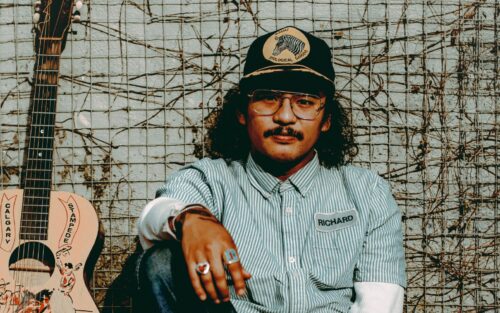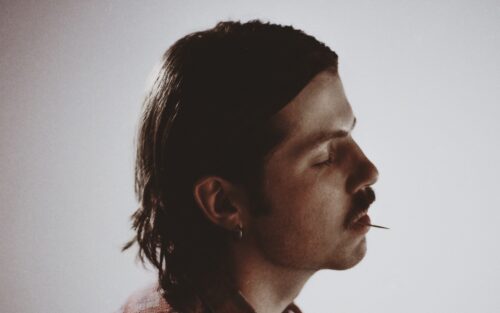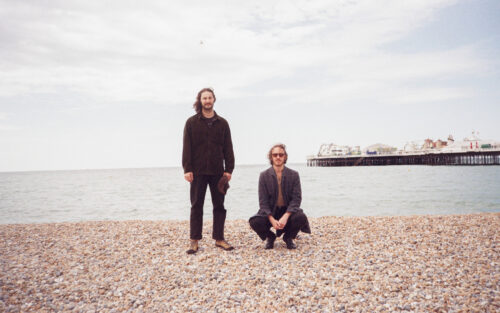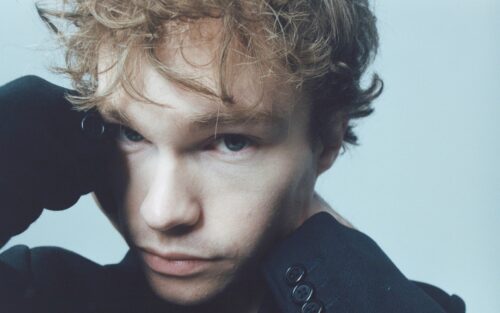
At the crack of midnight, d’Ecco waltzed on stage, donning the same Sound and the Fury T-shirt that Ian Curtis of Joy Division famously wore, and immediately went to work, dousing himself and the audience in his own spit and the contents of his tall can while screaming over the saxophone squeals that characterize his new LP, Scheele’s Green, to an audience eating up every minute of the half-hour set. It’s a kind of grandiosity that fits the content of the project: a ripping post-punk album about raging against the accelerationist machine, all contained in this box of sound that remains true to d’Ecco’s ethos while scraping the after-sleep scum off his more polished glam-rock roots.
Curious as to whether d’Ecco has it in the budget—or the tank—to pull off the same kinds of instrument-smashing manoeuvres at every show, or if I just got spoiled with a particularly conspicuous one, I have to ask if these stunts are to be expected. d’Ecco laughs at the prospect of being the kind of artist who’d wreck shit on stage in any way other than purely spur-of-the-moment, but that doesn’t mean the choices he’s making are entirely opposed to premeditation, especially while promoting Scheele’s Green. It comes naturally at this point for him, both as a musician who’s been working for a great many years and as a result of being a loud young child growing up in a working-class home.
“Ever since I was a little boy, going into drama and musical theater, then junior high and high school and playing in bands, it’s like…performance, being on stage, is like one sort of side of your brain. And then the creative energy that goes into writing and recording and composing and producing an album is another joy, but it’s a total other like manic excited sort of thing.”

Yet this project really marries those two forms of manic energy. The LP is, in a word, adversarial. As ever, d’Ecco is committed to the signs and symbols of the project, naming it after a Victorian colour fad and sign of opulence that was later found to be toxic due to its use of arsenic. In little splashes of literary, historical and film reference, the project comes together as a pastiche of modern folly, taking direct references to other works that critique the insatiable greed of the upper class and transmuting them into an indictment of burgeoning techno-fuelled misanthropy. It’s that lustrous sheen of literary and artistic reference that ties the project back into d’Ecco’s larger artistic language and glam-rock sensibility writ large, which still rears its head in the LP’s accompanying music videos, laden with Taxi Driver references and hopeful odes to destruction.
As such, d’Ecco wanted to translate that energy to the stage. Over and over again as our conversation progresses, he hammers home the importance of his ethos that “the medium is the message,” a catchphrase coined by Canadian communication theorist Marshall McLuhan, in his approach to music.
“For example, In The Sound and The Fury the prose is very avant-garde and as the acts continue, and you get into the second, third, fourth act, it starts to get clearer and clearer and clearer. It’s like the fog of the window is being rubbed off. I just found that so poetic and so interesting—it just further cemented that idea you know, the message of the medium. If you’re going to scream about data centers, actually scream about data centers. Like, let’s fucking blow out my voice.”

On Scheele’s Green, part of that came through in his collaboration with his now-touring band, who had an involved role in both the musicality of the project and the process of bringing its story to life. It was the first time d’Ecco had created in such an involved way with a band, and he describes how much it allowed him to explore a breadth of play he may not have had access to working by himself.
“We had three days off in two months. We were literally punching the clock every day. It was such a joy to go into work and experiment. We did so much experimenting in the studio, the album sort of was codified under this creative energy.”
It’s an easy switch in the long run, d’Ecco notes, and a luxury of play that not all musicians are able to retain.
“I think as a songwriter and as an artist, it’s like it’s really a muscle. I think a lot of musicians, you know, they they’re so obedient to their audience— you get a little bit of radio success or you get a little sync money or you start to build a fan base over this one thing that you do becomes very, it becomes harder and harder to like, deviate from that. But I’ve never had enough success at one thing that hasn’t, you know, like, shackled me to it. But I’m also like, I’m just very curious about a whole bunch of different areas. So, you know, you pull your antenna, like, medium, and you just always have it, and if anything strikes your fancy, you write it down, you revisit it later.”

Despite the chaos and toxic leech of the project’s subject matter, d’Ecco is still able to find hope in fleeting moments of Vancouver city life: the stillness against the city bustle and the access to nature that comes so readily at our doorstep.
“I would go for these three hour walks with no headphones in, and I’d just be forced to let my mind wander. Sometimes I’d be making up songs in my head; I’d go to Stanley Park and walk through the trails just surrounded by these giant trees—had a couple of good forest cries not gonna lie— and I just found that being in a city and having proximity to hustle and bustle and chaos and people wasn’t quite enough. It was about getting outside and putting this fucking thing down” d’Ecco gestures to his phone, “and just the adventuring one has at their fingertips in a city like Vancouver, having real relationships with nature has just been the best.”
It’s a welcome respite from the silicon and hyperactivity, and something d’Ecco believes is always worth continuing to fight for.