
Starring Sebastian Stan, sporting a shaved head that runs counter to his typically dapper screen persona, and Renate Reinsve as a conservative Christian couple, the film follows their rigid religious beliefs into controversy and a rigorous battle with social services after their disciplinary methods are alleged to constitute child abuse. Set in a quaint, progressive Norwegian town, Mungiu’s film immerses us in the profound quandaries of a private life exposed to public scrutiny—and eventually into the hands of clashing mobs.
Here, on Mungiu’s painfully stripped-down cinematic canvas, any cause—no matter how righteous or misguided—can be weaponized at the expense of genuine human connection and innocence. The result is a film that breathlessly evades easy categorization, one that can seemingly be accused of being both the most right-wing and the most left-wing movie of the year.
It is, in many ways, precisely the effect Mungiu deliberately set out to elicit. Rather than prescribe a definitive reading of his characters and their circumstances—with many sequences deliberately leaving themselves open to interpretation, and misinterpretation—he seems to relish the discomfort and agitation of a film capable of producing diametrically opposed reactions. As he tells RANGE at the Toronto International Film Festival, “I’m very happy that you say that some people see it like this, that they see it as a right-wing film and as a left-wing film. Actually, it encourages them to think, and I hope they will understand that I don’t have my own position as a citizen in the film.”
Fjord, like the splitting snowcaps, sliding avalanches, and shifting port waters that abound throughout it, wants to challenge the safe harbours we cling to. “The purpose is to make people with very strong beliefs listen to the point of view of somebody else,” Mungiu tells RANGE. “Because I consider that the main problem in nowadays society is that we live in our own bubble, surrounded by people sharing the same view with us. We watch films that confirm that we are on the good side of things. And this is what prevents us from understanding that there’s a very big portion in society of people who have completely different opinions, but they believe they are right as well.”
He ponders, “So how are we going to get out of this situation? Because society is fractured, it is radicalized. These people, not only that they don’t communicate, but these groups, sorry to say, they hate each other. If you watch the comments on social media…they wouldn’t mind if the other group vanishes completely, and this is not the society in which you can raise your children.”
As Fjord carefully demonstrates through meticulous character work, conversational interplay, and heated implications, Mungiu sees neutrality not as an absence of conviction, but as a means of forcing opposing perspectives into critical, crucial conversation. “You need to get back to be more reasonable, and we need to agree on some basic principles, and also on the fact that it’s OK to disagree about most of the things,” he explains. “So this is the purpose of the film and the only way in which I could make each group listen to the opinion of the others is by being neutral, by acting as if I’m a moderator of a conversation in which I quote these two opinions and I don’t take sides and I don’t pollute the film with my own opinion as a citizen.”
For Mungiu, that neutrality is also a thematic and dramatic responsibility toward his characters—and, by extension, his audience. “In a private conversation we can talk about this, but you can’t be judgmental with your characters. I can’t do something, this is an ethical thing,” he says. “And it’s important for you as a spectator to use a little bit your critical spirit.”

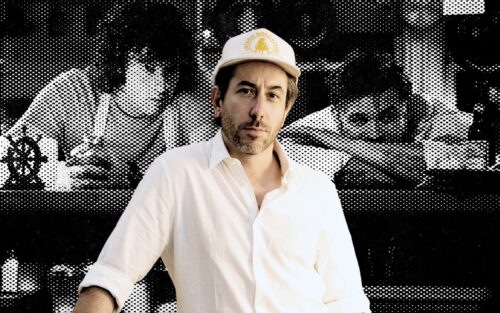
Cristian Mungiu and Sebastian Stan at Toronto International Film Festival.
Such a staunch commitment to impartiality is also a product of Mungiu’s signature restraint: a scoreless, naturalistic style that routinely forgoes sentimentality and melodrama in favour of earned emotion. Every clenched fist, quiet impasse, and lingering silence becomes a vessel for mounting feeling, allowing emotions to swell organically without the film ever going out of its way to wring them from the audience. “I like dramatism in film, but not melodramatism. I don’t want to make a telenovela in which everybody cries from scene two,” Mungiu says, pointing with force. “And I think that this restrained form and this respect for the truthfulness of the film without fake tears helps the spectator to get more focus and more attention on the themes of the film.”
Subtle pans and zooms give way to painfully still wides, each scene forcing audiences to sit with its murky grey areas and conflicting positions—especially as the film morphs into an arresting courtroom drama. “I don’t want to seduce them with music and with editing, as you see. I try always to put the reality the way it is, and I’m not using this kind of vocabulary of bad cinema, because in this way, I think that they are closer to what the characters express, to the arguments,” he continues. “I want to use my talent as a filmmaker to make you feel and experience what the characters feel in the film and to make you feel all this tension, but not by using these very simple tricks like music and editing, just using their real feelings. And this is why my work with the actors is very, very important. I try to make them express this and to make the spectators follow what they feel. And this finally gets them to be closer to the characters and to feel that these could be real people that we need to respect and to understand.”
At the heart of Fjord lies Sebastian Stan’s searing, implicitly impassioned performance as a father caught between his religious convictions and the nation’s progressive ideals, desperately willing, at first, to go through official channels, and then to pursue every external tactic at his disposal to get his children back from the state’s clutches—even if it means inciting dueling mobs and fuelling an increasingly heated internet discourse. Yet for Mungiu, casting Stan against type was precisely the key to unlocking the film’s divisive Pandora’s box.
“Can you recognize Sebastian Stan in the film? This is the question,” Mungiu asks pointedly. “I don’t want to take advantage of his looks. I mean, he has so many fans. So many write to me on Instagram saying, ‘Hey, you know, we love Sebastian that much that we will come watch the film even if he’s bald.’”
Rather than capitalize on Stan’s familiar Hollywood image—the product of countless turns as Marvel’s Winter Soldier—Mungiu deliberately strips it away. “I wanted to use his talent, first of all, to show that he can be a dramatic actor, not his looks,” he explains. “We agreed that I will help him to be as close as possible to his character. And this physical change really made him closer to a character for whom it doesn’t—it has no sense that he looks good or not. That’s not important for really a believer.”
Stan’s transformation, then, becomes part of the careful character work rather than a mere aesthetic choice. “So, Sebastian went with me, when we were preparing the part, to try to understand how these people are, and his physical transformation is a part of it. I agreed with [both Renate and Sebastian] that they need to look like the characters and not like themselves.”

Still from Fjord.
It all coalesces in a film that uses its purposeful style, myriad themes, and grounded performances to enrich its Scandinavian setting, which, for Mungiu, was the perfect battleground for clashing perspectives, opinions, and lifestyles. “The film speaks about these issues which are everywhere in this Western society in which we live. But the film is placed in Norway because we always associate Norway and the Scandinavian countries with the most liberal and progressive countries in the world. At least this is what we do in Europe,” Mungiu explains.
He continues, “It’s easier for the conflict to develop itself there…the reason is that all these countries, because they are sure that they have reached this very good standard in society with the right values, also have this very strict regulation about children. Somehow, they got to believe that because they progress so much with their understanding of the world, these values need to be passed for the next generation.”
In zeroing in on the moral and socially progressive fabric of nations like Norway, Mungiu’s film dissects the contradictions that emerge when migrants, like the conservative family at the centre of Fjord, do not neatly fit within a nation’s self-prescribed matrix of values. The film’s conflict consequently becomes about more than a family fighting to get their children back; it becomes a collision between competing ideas of what constitutes a good life, a good parent, and ultimately, a good society.
“If you as a parent coming from a migrant family, pass these values, it’s all good. But if you don’t, the society believes that it has the upper hand on your children… they will take over into passing these values, and the extreme side of it is that sometimes they will just take the children to make sure that they become the citizens of this new good society, which in principle is a good idea,” Mungiu explains. “It’s just that you need to convince people. You can’t impose your values on people because then you’re not better than the conservative society that we all criticize. We expect more from a progressive society.”
For Mungiu, the question ultimately comes down to the uneasy but necessary boundary between persuasion and coercion, and whether a society can uphold its principles without breaching the individual freedoms it claims to enshrine. “You know, I come from, you know, a communist country, so I don’t like when people know better than me what’s good for me. Let me be stupid, you know, but that’s my freedom. And it’s good to understand that we need to be more tolerant with the other and to understand that we need to integrate their point of view.”
Primed to be one of awards season’s more divisive contenders, Fjord beckons us to scrutinize every detail, resist the urge to impose an easy reading, and arrive at the difficult answer for ourselves. Yet, despite it all, Mungiu’s film retains a cheeky, wry verve, finding beauty and resolve in the very society it simultaneously scrutinizes.
As the conversation comes to a close, after a long discussion dissecting the foibles and failings of the nation he’s captured, Mungiu offers one final, mischievous reminder: “You can go to Norway. It’s a very nice country.”