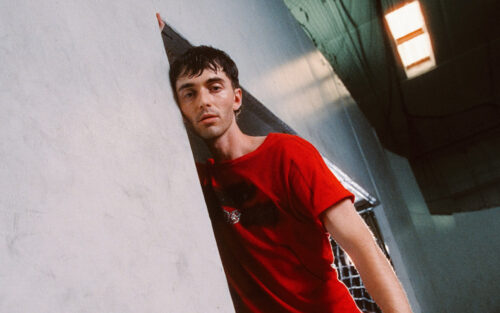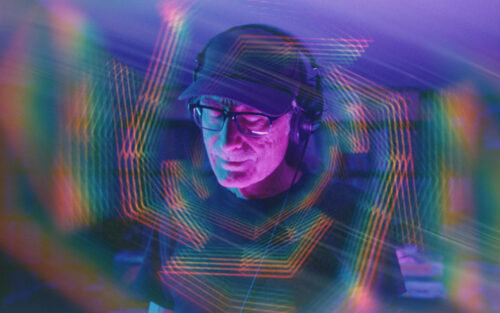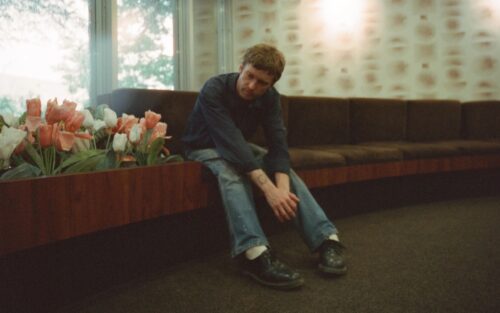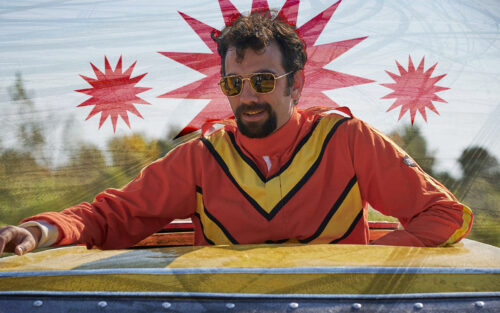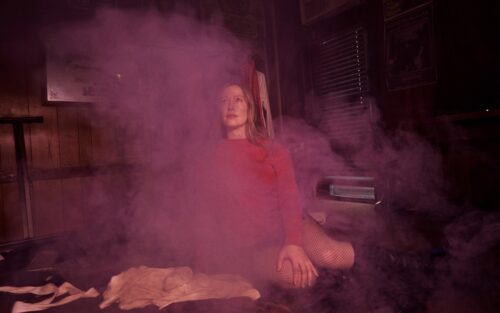
“It’s really intense,” Alan Duggan, Gilla Band’s guitarist, tells me. “But it’s also kind of meditative in a way. It’s all a bit strange. We were trying to push Dara to do that [in recording]. Like, keep your lyrics, but deliver it in that way.”
It makes sense that a mourning ritual would evoke something in the process of Gilla Band’s third LP, Pugnello, because it’s common to hear the same report of meditative deliverance about being at a noise show. It’s a haptic process felt in your body, and a similar form of catharsis—emotions that are fitting to the subject of grief. Pugnello wrestles with different forms of release and reconciliation, playing out through descriptive relics of vocalist Dara Kiely’s childhood, the schizophrenia diagnosis he received during the five years of the album’s creation and, most frequently, the death of his estranged father. The title Pugnello is borrowed from an unpublished manuscript about a cursed font of the same name, written by Kiely’s uncle. The project is littered with personal symbolism, rigor mortis and warding spells.
With this kind of introduction, you’d think Pugnello would be a haunting and unrelenting mass of a record. It certainly is in some ways, but it’s also touching, funny, complex and perhaps the most danceable work in their discography.
“I quite like writing something where someone starts to dance to it, but they don’t know why they’re dancing,” Alan notes. This was part of the charm of making drum machines and synths a major focus of the album. The project finds a narrative in the rhythmic, occasionally repetitive notes of aging, swaying and social awkwardness. It’s a collage of pop culture references and salient conversations, a flurry of words spilling out of their seams.
This has long been Gilla Band’s gift: the ability to blend haptic fuzz and tech-heavy, 20-pedal distortion setups with dry witticism and emotional vulnerability, lilting on regular notes of humour. They’re maybe the only noise-rock outfit that could pull off a lyrical admission that they’re “blaring dangerous amounts of Coldplay,” multiple Bananas in Pyjamas references, or a song that begins by categorizing corresponding chip flavours to Oasis and Blur, while still making a coherent, let alone thoughtful, album.
Especially on Pugnello, Kiely’s lyrics feel like poetic transmissions, a Morse code blipping in the corner of a television set over sugar cereal commercials; a ghost in the DV tapes of your family’s home videos.

“I feel like Dara’s lyrics are so Irish, in a way,” Adam Faulkner, the band’s drummer, admits, referring to the mentions littered throughout the project of ’90s daytime television and overbearing Irish motherly love. “It’s always very like, ‘Oh, I know what that was like growing up,’ you know, in the ’90s, at the same age. And so, whether that’s like, I don’t know, Crazy Frog, there’s always this shit, like, you know what I mean? He always has these kinds of lines. He’s very good at making metaphors and drawing comparisons between things that you wouldn’t necessarily think of—the ability to remember things that were formative, then make them relevant to what he’s thinking about. It’s always very impressive.”
Pugnello also switches between modes in rapid succession, a major notable departure being the track “Computer Sadness,” which takes a page from Neil Young’s Trans—a similarly strange project about grieving and transmission.
The album began taking shape right after the band finished their previous album, Most Normal, in 2022, with songs created over the years between. Though there’s a strong thematic throughline beating through Pugnello, the LP didn’t find its own shape until spring of last year.
“What we’ll usually do when we get to a certain point making a record is, like, we’ll cut out all the track titles on little pieces of paper and just kind of put them all on the ground and split it into, like, okay, that’s the A-side of the record and that’s the B-side of the record,” Alan describes. “That’s usually quite telling then—like, oh, we’re missing some tracks, or what out of all these tracks is the record?”
The two are set up on swivel chairs inside their windowless studio. In the tiny field of view allowed by Zoom, the space seems small and cramped, with broken cymbals, wires and shelves full of Rube Goldberg machines uncontainably (but clearly labelled) spilling out of their bins. This is where all of Gilla Band’s studio albums have been created and workshopped. It’s been theirs since roughly 2011, and it’s apparent—the space is packed.

Noting the sheer amount of things in frame, I jokingly ask Alan what the weirdest item they have in the studio is. He walks to the back shelves, revealing the room’s depth, to grab a white block of unidentified material with about 20 wiry metal rods sticking out of it. It’s a pedal… sort of.
“You’re supposed to hit the rods… there’s loads of overdrive in it,” Adam clunkily explains, the two giggling at the strange hodgepodge nature of the item and its hard-to-parse construction.
It’s not lost on the two how absurd the instrument looks, or that it offers a small glimpse into the clearly oblique language and working process the four have developed in their music. They tell me they’ve been working as a band for some 15 years now, and it’s their main source of continuous emotional processing and unwinding.
It’s a bit surprising to hear this, because the two are part of a project that’s frequently heralded as a marked turning point in contemporary rock’s landscape, a shift away from the saturation of “landfill indie” bands of the mid-2010s and into heavier sounds. Ask the guy at a show counting time signatures on his fingers and gleaning pedal chains what his current musical inspirations might be, and there’s a good chance Gilla Band will show up as one of those names. But, as is often the case, this isn’t enough to make music an entirely full-time gig for anyone in the band.
“I had some personal things going on that meant that I was a little… I wasn’t around as much for certain chunks of [working], which was hard going,” Adam explains when I ask about the difference between working on this project and their previous albums. “When you’re writing a record over that length of time, life will get in the way a little bit; and because we were doing this part-time as well, it’s not always that everybody’s focus is down here five days a week.”

Despite the tough balancing act of working on music and trying to slot your life around it, I get a sense that this is equally a blessing: it keeps the work fun. The two tell me that Dara works largely in peer support and mental health; Daniel is a producer for a handful of other projects (Lambrini Girls and Mandy, Indiana, to name a few); Adam works as a sound engineer for a handful of venues; and Alan teaches music business at a music college in Dublin. This offers a bit of balance between the often heavy subject matter that finds its way into their music, the time they spend down in the studio and the rest of their lives.
Despite Pugnello’s disposition, the technical complexity of their work and the tension and release of their entire discography, there’s a sense of levity in the way the bandmates speak about and interact with each other. It’s a sensitivity and understanding that comes with having worked together in the same room since 2011, and it’s kind of refreshing to see from people making this type of project in a genre occasionally wrought with braggadocio.
“I think it is something that we’re all, we try to be really mindful of—whether it’s Dara or whether it’s, like, anybody else in the band going through anything—we all like to be helpful and supportive. [The studio] is a place to be comfortable in the sense that, like, if you’re going through something shitty, we can talk about it with each other and whatever else. But also it’s a release or escape to just get down here.”
Adam adds: “When you kind of come in and you close the door, the outside world does literally cease to exist, which is kind of mental. You know what I mean? Even though it’s like, you know, we’re slowly looking at each other’s age, but it’s all still against the same background.”
Perhaps this is an insight into the truth of working together for so long, but it also feels like a thematic statement on the album. Nothing ever really leaves us; it just grows into its shape.