Now, as the record makes its way into the world, the singer-songwriter has found his way back home to Oklahoma, grounding himself in gratitude and embracing all the feelings that come up when releasing such a personal record.
Release days can sometimes feel like a double-edged sword, Chance admits. While celebration is in order, the weight of both the lyrics and stories at play can bring-up all kinds of emotion.
“I think I learned a long time ago that I give myself a lot of grace and a lot of freedom to feel however I want to feel after releasing something. This week, I feel very proud of the album, and it’s been so cool to see fans interacting with it, but it’s definitely been a reminder of the origin of it, and it’s been a little sad, but that’s okay. That happens sometimes.”
That dichotomy has existed for Chance since the extremely public and rapid rollercoaster that was his rise into fame – you might remember Chance from his viral cover of Lady Gaga’s “Paparrazi” at just 12-years-old. Without a moment to breathe, he signed his first deal the same day he made his public debut on The Ellen Show, and was thrust into an industry that left little room for him to simply slow down and feel it all.
Now, Chance makes time to feel, and BOYSTOWN reflects that.
The records’ title track cradles Chance’s soaring vocals in stunning string layers. “I wanted that ’80s power-ballad feel… It’s totally different from the rest of the record. As my mama always said, people love to hear me sing. And I sing my ass off on that song.”
He doesn’t hesitate to give credit where credit is due: “I don’t exist without Justin Vernon’s art in the world. I also don’t exist without Bruce Hornsby and Peter Gabriel and Bruce Springsteen,” he says. Chance also worked on the record alongside Ontario-local John Fellner, who he deemed simply “the right person for the job.”
While BOYSTOWN is his fifth studio album, he admits that it was his first that felt fully independent, “I wrote it, I executed it, I paid for it,” he says. “Most of the artists that you’re listening to don’t own their music, so to have something that I know is an asset is cool as an artist. It’s an investment in myself, in my craft, in my artistry.”
What prompted this dive into full-throttle independence? Knowing what he was dealing with, and completely trusting that after close to twenty years, he knew what was worth waiting for and when he needed to be the one in the driver’s seat.
“I’ve had a really rocky two years. My last album was – what? Palladium came out four years ago. I’ve been working on different projects and different lanes genre-wise, for the past four years. I was really struggling to find a direction for something,” he explains.
“In the interim, I’d also gone through two different failed label ventures, meaning I had deals that were weeks and months spent going back and forth with a record label. At the last minute, both times, it was pulled out very close to the end of it. I just felt like, ‘Okay, no one fucks with me right now in music. Cool. Got it. Understood. Totally fine. But what am I going to do with that? How can I make a shift, and how can I do things?’”
“It just got to a point where I thought, ‘You can either continue to take meetings, or you can take a step in a different direction and just prove it on the court.’”
Chance didn’t wait for the right moment or another opportunity to come along, he simply took the leap: “I think, for the first time in my career, there was no second-guessing anything.”
The result is an album that moves fluidly between diverse production, intimate storytelling and deep-cutting honesty, all anchored by a searching exploration of self-identity.

The first three tracks on BOYSTOWN offer up a much more pop-centric version of Chance’s musicality, almost night-and-day in tone from his last record Palladium. “SAND” and “DIRTY LAUNDRY“ even veer on dance-pop yet still hold onto achingly confessional lyricism. “Why is it that men are so fragile when they hurt the things they love?” he croons on the latter.
There’s one track in-particular where you can really hear him let loose and break through the shackles of innuendos: “I say on ‘BODY DELIGHT,’ ‘I like to get violently high.’ I was just like, ‘If you like it and it makes you feel something, and it’s a part of the story that you’re trying to craft, just go with it.’ I didn’t really look back. I was also outrageously high during all of this,” he laughs.
Similarly, Chance also sings, “I like good dick. I like sunshine,” a verse aphoristic by nature. “I was having fun. I was just enjoying it. In previous years, I would have looked at a lyric like that and said, “I like it, but it’s probably a little too on the nose.” But this time I was like, ‘Fuck it. It’s on it…’ Holy verses type of vibe. I love good dick, and I love sitting in the sun.”
Amidst the fun, the grit, and the honesty, Chance finds evolving throughlines throughout BOYSTOWN. He describes the record as an exploration of himself at 29: a man who grew up in Middle America, approaches love with loyalty, finds joy in his queerness, and is still figuring out how all the pieces fit together.
“If I really get academic on it, it is an examination of the queer mythology, but as it exists in America… There is so much to be said about gays in strange places and how I choose to live in Oklahoma. If I tell somebody that – and I’ve lived in L.A. for a long time – I live in Oklahoma, they’re like, ‘Are you okay?’ They can’t even wrap their head around it.”
BOYSTOWN lives in the contradictions between staying and leaving, belonging and alienation, and the freedom of knowing oneself while still figuring out where that self belongs. Rather than neatly resolving those tensions, Chance finds something worth celebrating in their coexistence, offering reassurance in the knowledge that not everything needs to be figured out at once.

That same willingness to embrace uncertainty extends to love, passion, and art. For Chance, all three require a certain willingness to dive off the deep end – to believe in something even when there’s no guarantee it won’t hurt: “You have to believe in love in order to wake up every morning and go through it. It’s suffering, and it’s going to throw you up against the guardrails, and it’s going to destroy your life for a second, but you have to do it.”
It’s a philosophy that Chance seems to have applied to BOYSTOWN itself. The album is, in many ways, the product of that same willingness to take a risk, even when there was no guarantee it would work. It encapsulates the ballsy nature of making a record fueled by true, authentic artistry at a time when honesty can feel hard to come by.
Chance has many more tricks up his sleeve for this new era. “I have no intention of leaving this space for a year and a half,” he says. “I want to be really prolific. I want to be fast during this period. So there’s already new songs. I’m going to put out a lot of music in the next year and a half.”
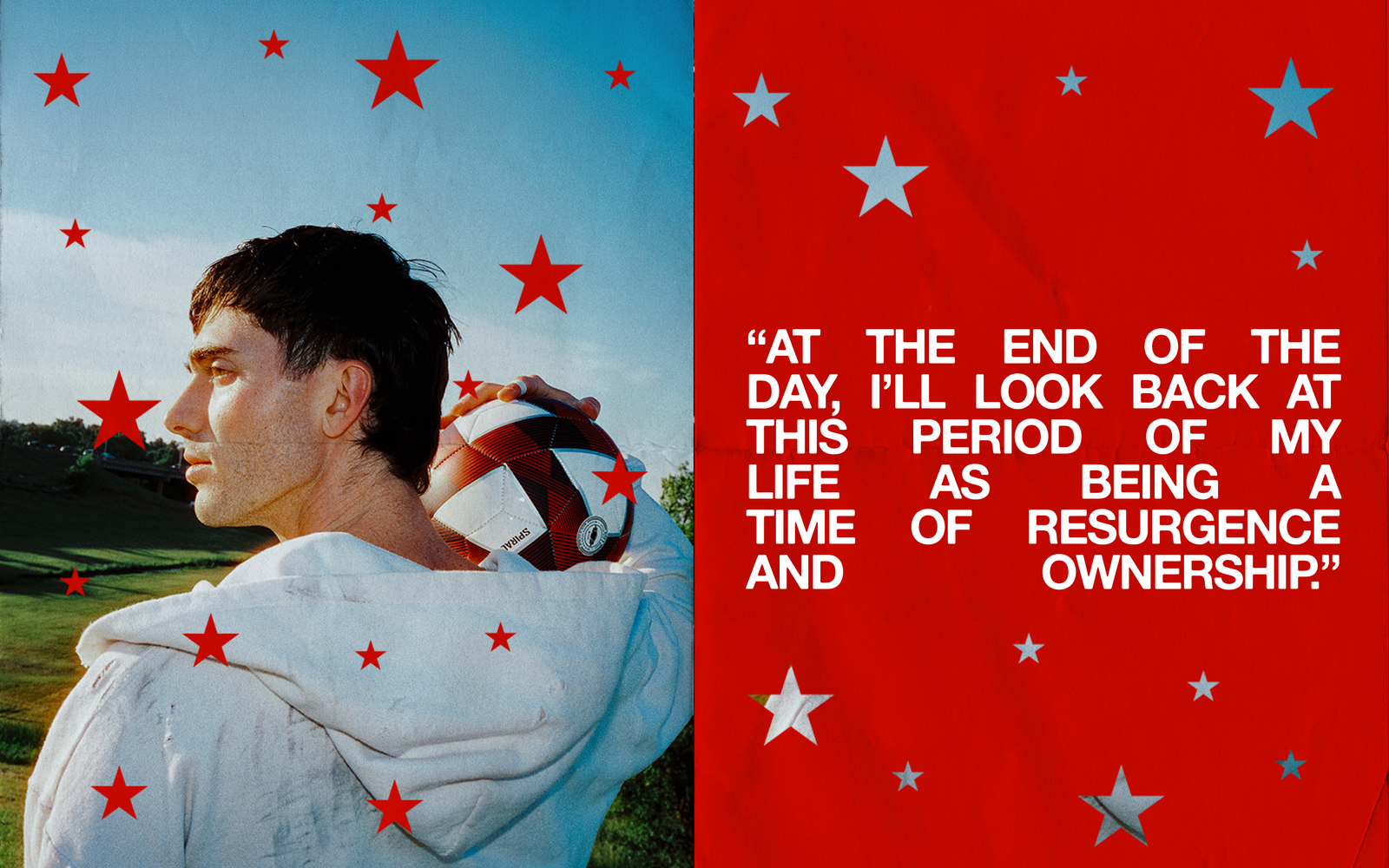
But for now, BOYSTOWN represents a moment of autonomy – one that Chance says he’ll look back on with pride, even if the process itself was at times painful. “At the end of the day, I’ll look back at this period of my life – even though, yes, it is sad at times – as being a time of resurgence and ownership. I think that’s cool.”
For an artist whose career has been shaped by unexpected turns, setbacks, and reinvention, perhaps the greatest takeaway is not knowing exactly what comes next, but knowing that he finally trusted himself enough to find out.
“My goal with music has been so unconventional from the start. It’s been layered with landmines and surprises and different things throughout the course of it… I don’t know where my career is going to go or what my life is going to look like, but I know that this was a chapter in which I fully believed in myself and just went for it.”