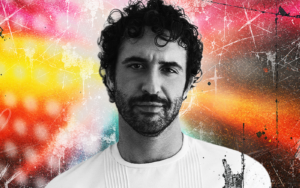


In his feature directorial debut, the writer, director and star plays Peter, a party promoter and purveyor of party favours whose carefully prolonged adolescence is interrupted by the arrival of Arlo (Reggie Absolom), the son he never knew he had. What follows has the framework of an accidental-dad comedy, except Firstman transplants that familiar premise into a queer New York community rarely afforded the luxury of being this messy, funny or complicated onscreen.
That contradiction is by design. Firstman wanted Club Kid to feel familiar enough to welcome audiences inside, then use that comfort to take them somewhere more complicated.
“I think I always wanted to have this familiar framework so I can tell this kind of subversive story underneath and make it understandable,” he tells RANGE during the Toronto International Film Festival. “I care about my audience, and so it’s about making dangerous things feel safe in this movie.”
Firstman continues, “Sometimes when you see drugs in a movie, you’re just like, ‘Oh my god,’ but I think in this movie, it’s so normal it doesn’t feel so scary—you can still be ingesting what this community is and the love that’s in the community, while also some of the problems.”
That sense of authenticity comes naturally to Firstman, who has experienced the community’s vibrancy firsthand. Rather than manufacture a version of New York queer nightlife for the screen, Club Kid captures an energy, belonging and spirit that already existed—a feeling that permeates everything from the film’s sweaty, drug-addled atmosphere to its casting.
“The New York queer scene has always been the scene in America—you had the actual club kids in the ’90s and ’70s, when gay people were fighting for their rights and they were cruising in Chelsea—so there’s such a richness in the queer space in New York I just wanted to show,” he explains. “And I’ve partied a lot in New York, and you don’t have to do much; they’re just so lively and filled with energy and personality and love, so I think just finding the right people and putting a camera on them did a lot of work for us.”

That instinct extends to a cast populated not only by professional actors, but by newcomers, non-professional performers and figures drawn directly from the city’s nightlife and cultural ecosystem—including that spirited cameo from Shygirl. The result is less a recreation of queer nightlife than an extension of it: a film whose most convincing elements often feel less performed than simply lived and experienced.
Club Kid is also a vibrant rebuttal to conventional perceptions of what queer characters are expected to be. Against the tendency to sanitize queer representation into something inspirational, aspirational or neatly well-adjusted, Firstman’s film allows its characters simply to be—messy, chaotic, contradictory, selfish, funny and flawed, without burdening them with the expectation of representing anything beyond themselves.
“I never for a moment thought that this film needed to represent anyone in any type of way. I just wanted to tell an honest story with interesting characters,” Firstman says, leaning forward in his chair. “Even with Oscar’s character [Diego Calva], I was like, I don’t want him to just be this saviour for my character. And you look at him, he’s being a pretty shitty therapist—he’s immediately throwing out a kid for some guy,” Firstman says with a chuckle. “I wanted every character to have these complicated human emotions, and even the trans characters, not treating them like perfect people, because it’s not real.”
Firstman continues with a declarative, almost playful conviction: “I think the best way to show a wide audience and make them comfortable with people is showing humanity. And if you’re showing queer people as just those who struggle and rise above, it’s not relatable.”
He leans back. “So I think we are way more relatable than people think—we’re funny, we’re creative, we eat food, and we’re just normal people.”
That same commitment extends to the film’s lush, layered soundtrack—a treasure trove of needle drops that not only tap into the fabric and frequency of a particular moment or setting, but externalize the headspaces of its characters. Spanning everything from Kelela and Massive Attack to Cocteau Twins, Ninajirachi, and even Death Grips, the soundtrack operates as an emotional collage, its curation becoming another means of articulating the film’s specificity.
“No one ever mentions the Death Grips needle drops!” Firstman ecstatically interjects. “I’m so happy you said that because no one ever, like on Letterboxd, everyone mentions everyone but Death Grips, but it gets the vibe of that, like, cracky apartment. It’s like, of course they’re blasting Death Grips.”
He continues, “What music does for us in our normal lives is it creates mood. We seek out music based on the mood we’re in, or we let a song change the mood we’re in. So if I’m feeling sad, I’m going to put on my Phoebe Bridgers or my Frank Ocean or whatever”—he gestures with his hands—“I mean, cry. If we want to pump it up, I’ll put on my Rihanna. And then we have the house music at the party. Music is such a powerful tool in filmmaking for mood-shaping, and I really didn’t shy away,”—he rubs his head in awe—“There’s so much fucking music in this movie.”
For Firstman, the music also lends texture to the dynamics between his characters.
“Peter is around music all the time, but he’s so, like, underneath the scene, and he’s kind of fallen out of love with music. And I think Arlo [his new, sudden responsibility] actually makes him fall back in love with music, and that shared playlist they have, I think it teaches him—it reopens Peter’s heart to what he originally liked about the scene and about music and makes him just feel more alive again through that.”

For as much as Club Kid unfolds as a kaleidoscopic collage of musical influences, its touchstones extend beyond the soundtrack into its refined, detailed cinematic language, folding ’70s New Hollywood influences and ’80s and ’90s New York City classics into its uniquely tender story.
“I love Paul Mazursky. An Unmarried Woman was a huge visual reference, and tonally, like, the way he lingers on shots for a long time and lets the characters breathe… so that was my gold standard,” Firstman continues. “And then, you know, [Martin Scorsese’s] After Hours, and even Andrea Arnold in a way, like American Honey, like the way she films group scenes with the friends. I really wanted [my characters] to feel like this gang of, like, amazingly beautiful misfits in a way, but it was important this movie had a very classic feel.”
He adds, “I wanted it to feel like a comfort movie in the ’90s. So it’s like, yeah, the ‘Big Daddies,’ or even, for some reason, One Fine Day with George Clooney… the colours are so just like New York ’90s fall colours. So we referenced that visually, like even When Harry Met Sally—like, we wanted that lush New York nostalgic feeling for it.”
Looking up into the air, he notes, “So it makes the party stuff easier to digest because there’s a comfortable nature to the way the movie flows at its surface. And then I can, like, hide my subversive stuff underneath that.”
That’s perhaps Club Kid’s greatest sleight of hand. Beneath its kaleidoscopic soundtrack, lived-in textures and deceptively comforting rhythms lies a debut that quietly dismantles some of the expectations imposed upon the social sphere it captures.
Like the people peering in from the outside at Peter’s world, hoping to sand down his rougher edges, Firstman refuses to clean things up for their benefit. Club Kid becomes something more than a portrait of queer nightlife or an unconventionally heartwarming coming-of-age story. It’s an exuberant celebration of the freedom to simply exist, learn and grow through the mess.