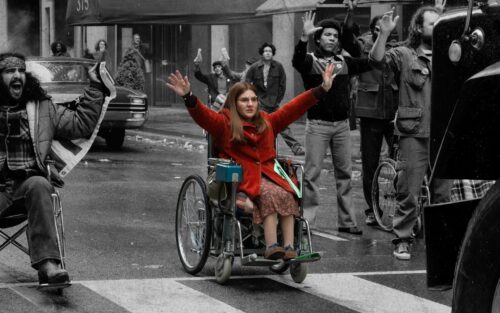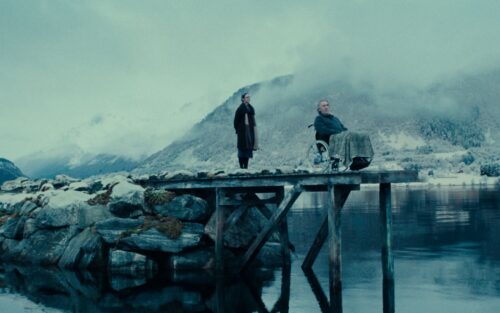


After offering several options that were met with placid rejections, the frustrated Mothersbaugh went back to the score he’d composed for The Royal Tenenbaums three years prior, pulled a piece from the film’s pivotal Central Park scene, and played it backwards. The elated Anderson declared that the piece was perfect. “I decided then I wouldn’t tell him he already owns this music until after I recorded it,” Mothersbaugh laughs.
This is just one of a multitude of strange, insurgent and utterly charming stories that Mothersbaugh casually drops during his conversation with RANGE. They come as no surprise. After all, the mastermind of legendary art punkers Devo and revered champion of all things warped, singular and asymmetrical, has been a vitally disruptive force in the music industry for more than five decades.
Even as our interview starts, the first thing Mothersbaugh does is show me his hands, inexplicably stained black, and asks if he has any smears on his face. He assures me he’ll avoid touching his face, and then proceeds to do just that incessantly throughout our chat.
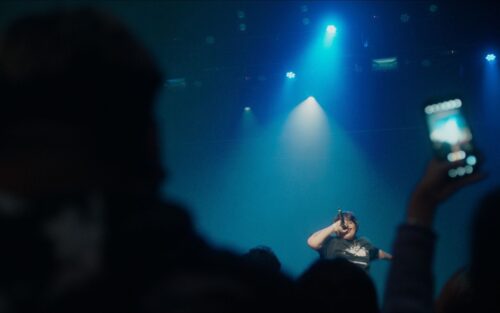
The brilliant iconoclast has recently played Vancouver on Devo’s reunion tour with the B-52’s. But on October 8th, he will be returning to the city, to bring his sublime film score catalogue to the Playhouse at the Vancouver International Film Festival, staging a series of his most beloved pieces with a 13-person ensemble. In some cases, this will require taking colossal sequences written for a 100-person orchestra and condensing them into that fold. In others, the skeletal synth-works will be expanded in the opposite direction. It feels like a perfect challenge for an inexhaustibly creative presence who has rarely shied away from challenging themselves and others.
“I love this thing we’re doing at VIFF. Some of the pieces are from Bottle Rocket, where a very small group of people were originally playing on it. And then some of them are from Thor: Ragnarok for a massive 100-piece orchestra, with 60 synth tracks on some of the cues. Reducing it really focuses the theme. You really hear it. When I was 19, I was obsessed with the 1920s, all these art movements – Futurism, Dadaism, Surrealism, Bauhaus. And I thought about cabaret, how music was performed in that era. This will be close to all of that. It will be very unpredictable, but I also know that it’s going to be a treat,” Mothersbaugh muses.

It’s always strange to know that Mothersbaugh, an immensely influential trailblazer of a very specific angular and hyper-articulate punk music and a survivor of one of the most vicious culture wars in the history of the States, has long been making a trade in composing for big commercial productions. But even then, his subversive nature always gets the best of him, and little Devo-esque acts of insolence can be found hidden and scattered across even his most mainstream work. Laughing, he remembers writing his first advertisement jingle for Hawaiian Punch.
“The ad looked a bit like a Devo show because they had robots that were dancing in unison at a factory. I used all these found sounds from a car repair shop. Early days of sampling, it was all so exciting. Then comes the point in the song where I have to say ‘Hawaiian Punch hits you in all the right places!,’ then the music kicks in big and there is a big drum fill,” Mothersbaugh remembers, chuckling. “I put a subliminal message underneath that. I said ‘Sugar is bad for you.’ So then we’re playing the jingle in the board room for Daley and Associates. There are all these suits sitting around, and one of them keeps tapping his pen along to the beat. It gets to the end and he yells ‘Yes! Hawaiian Punch DOES hit you in all the right places.’ And they all high-fived each other. They never heard it. And the jingle played for years.”
That dissident, guerilla approach stems from the very formation of Devo. Forged directly as a response to the Kent State shooting in the Spring of 1970, when the Ohio National Guard shot and killed student anti-war protesters, it was then that Mothersbaugh and co-founder Jerry Kassale began formulating and formalizing their Devo-lution theory, which addressed not only the nature of state-sanctioned killings, but the lack of response from the artistic community in its aftermath.
“We were all there protesting the war in Vietnam. And after the shooting, things went silent in the country. Instead of doubling up on outrage, the prominent music that came out immediately after was disco and corporate rock, bands like Styx and Boston. Their politics were – we’re white, horny, misogynist and we’re conspicuous consumers,” he remembers, his face still grave as if living it again and again. “We wanted things to be different, but I couldn’t see any possibility for change. Things seemed to be devolving.”
For all their optically schlocky affectations, the famed energy domes and the comedic aspects of their mainstream work, the reality is that Devo represented something very polarizing in music, both underground and on the radio waves. It’s difficult for younger generations to imagine how dangerous and intoxicating it felt to see these people play their futuristic, literary, uncompromising and alienating songs – danceable and desolate in equal measure – especially in the current age, when revivalists like Angine de Poitrine play these pivots out to no moral point.
Yet, here Mothersbaugh takes on an uncharacteristically optimistic view, saying that this most recent nadir in American history can potentially hold something more promising in the world of artistic protest. The way he sees it, the devolution he’s once witnessed will be countered by an upward stroke. That something beautiful and revolutionary may come from his pressure cooker yet.
“We have entered yet again into this generational time of disturbing greed and stupidity. However, I feel that we will see and hear amazing art come out of this. Artists should always be the first to respond to this. You will hear and see things and think – how come I didn’t think of that, it’s such a simple, amazing and powerful idea. A revolution is the result of the struggle between evolution and devolution.”
As we speak, Mothersbaugh and Devo are finishing up blazing a trail across North America on a tour with another staple of 80’s art punk – the B-52’s. For fans of obscure musical trivia, there is an odd little bit of connective tissue tying the two bands together going back to the very start. Mothersbaugh’s brother Jim had once worked for Roland synthesizers, and was the one who had shown the B-52’s how to use the equipment which would catalyze their kitschy, bopping keys.

Though the two bands have represented very different ends of the 80’s ideological art spectrum, Mothersbaugh is elated to be on the road with his old friends.
“I always liked the B-52’s. Like Devo, they’re an art band, and although what we talk about and how we talk about it is quite different, I think we’re complementary to each other. Devo is kind of a cynical, crabby band. Our thing is that everything is going down. And the B-52’s are happy and a partying band. On tour, you get these two great different energies. They look great on stage and they play really great. And I just love them. I remember the first time I heard “Rock Lobster,” it was amazing. And so— this is coming to an end. We have a few more shows and then that’s it.”
Here, a glint appears in Mothersbaugh’s eye, and he smiles.
“But you know, people say they’re retiring and they don’t always mean it, you know. So we’ll see, we’ll see.”
Between Devo, his boundless scoring work, his thriving visual art practice (he has been running a gallery and painting postcards every day for decades, building a collection of over 80,000 pieces), and the countless other projects he has cooking, it can be hard to imagine what kind of a mindset Mothersbaugh adopts for each of these ventures. After all, playing Devo’s jagged, high-velocity punk on stage sports such a drastically different energy from the orchestral and solitary synth work he puts together for film. But for Mothersbaugh, all of it, all of his tireless creativity, the insipidly catchy jingles, the dour provocation, the serrated punk, the phantasmagoric world, all pour out of the same place.
“I’m a wide enough person that yeah, this all comes from me. There is only one Mark Mothersbaugh. There is a lot of Devo in everything I do, just as there is a lot of anti-Devo. But it all comes from the same place. There is nothing I do that is a simulation. I might push for a cue in a film and the director doesn’t hear it the same, so I might have to change. But I still try to make it as good and as true as it can be.”
VIFF’s 45th edition runs Oct. 1 – 11. Tickets and Info: VIFF.