The track is preceded by field recordings of children describing what they’d like to be when they grow up. It’s the point where dreams begin to calcify on the record, and the place the rest of it works to come back from. Sexual violence and its aftermath are rendered through images of limbs sewn on backwards, a narrative eating itself and emerging with blood on its hands. Is this helping me, the song asks? Is this helping you to hear? What about to read, I wonder?
It’s a question I’ve asked myself often in the years I’ve spent writing about my own experiences with sexual violence, and one that might never have a satisfying answer. Catharsis can be lofty and costly without necessarily offering reprieve. Art is easy to make and, materially, often amounts to very little. Yet writing about violence can feel impossible to escape. At the same time, it is often victims who are asked to leave the subject behind in their work—to kill the personal, the “diaristic” urges within their writing.
you made me / skin on linen circles these same questions, attempting to understand a narrative that can feel unreliable, whether because of the instability of memory or because we live in a world that simply doesn’t believe you. Across original songs and audio clips from Andrea Dworkin, Manon Garcia, and the leftist militant group Rote Zora, the album assembles a collage of half-answered possibilities and attempts at reconciliation. It moves like liquid between anguish and repulsion, bare lyrical admission and calls to anger and direct action.
On that first track, lead singer Taylor “Tay” Zantingh repeats “I WANTED TO BE A SINGER,” bated and shrieking, over and over. But in the cadence of her voice, it becomes clear that she cannot just be a singer anymore. The comfortable, melodic register of making art without harsh edges has been forcibly taken from her. So she screams.

At this point, PISS probably doesn’t need an introduction. The band gained traction with a velocity unlike almost anything else to emerge from Vancouver’s DIY scene, accelerating toward a set at the iconic venue Windmill Brixton in South London, a record deal with Sub Pop and Paper Bag Records, and a KEXP session that captures the tension and volatility at the heart of their performances.
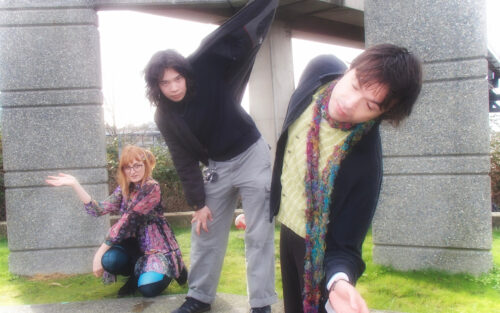
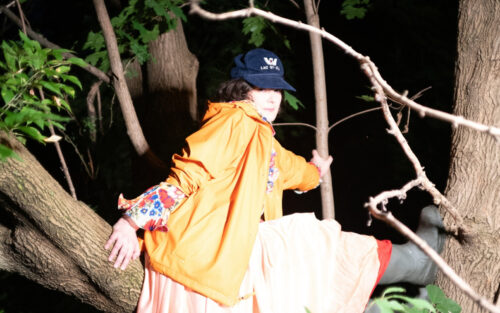
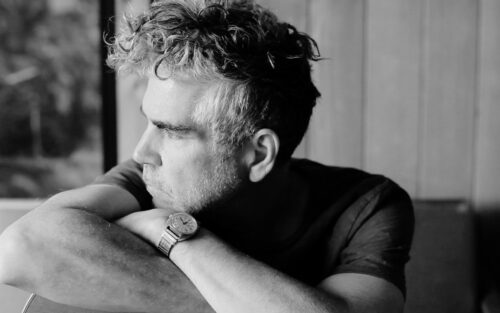
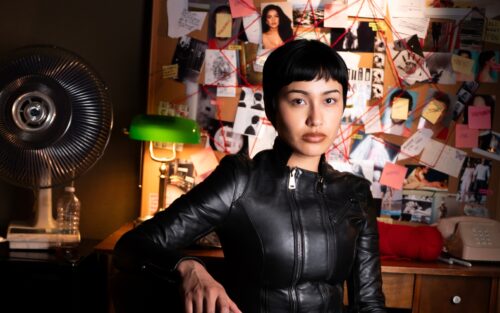
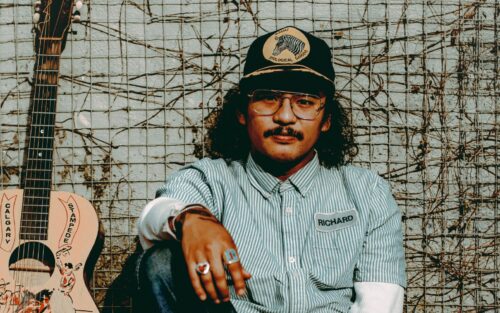
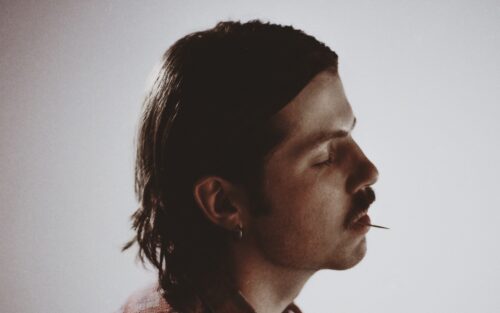
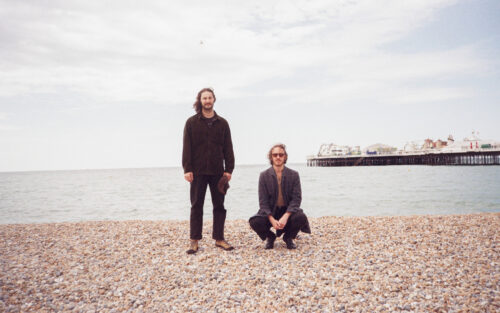
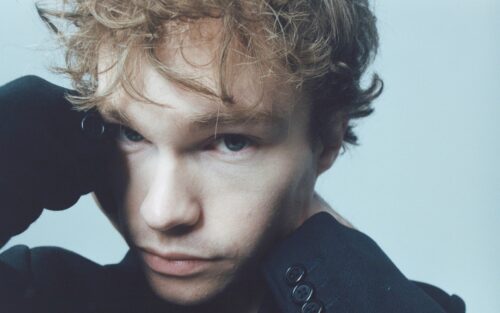
For any band, that kind of rise over only a few years would be dizzying. When Zantingh and her bandmates — Tyler Paterson, Garreth Roberts, and Gavin Moya — talk to RANGE, it’s their third interview of the day, with several more still to follow. Zantingh explains that they’re learning to find a balance between intentionality, narrative and raw feeling. It’s new for all of them, but they seem to be taking it in stride.
“I feel that my early creative life could be characterized by a complete and utter lack of shame, which has definitely resulted in some things that now I look back on and I’m like… yeah…” Zantingh laughs. She’d been playing in bands for years, first in her native Oshawa, Ontario, and later in Victoria, before Paterson (guitar) suggested she move into his place in Vancouver so they could make music together. She’s light but thoughtful when talking about the project, a characteristic that feels connected to the band’s success and perhaps necessary for performing regularly under the weight of its subject matter.
“I think that in Riot Grrrl, which is sort of the subculture that I was really obsessed with growing up, there’s none of that sort of trivializing of [deeply personal] art. It’s not something that I thought like, “oh, I need to make sure that I’m making this in a very literary way.””

you made me / skin on linen has been described in plenty of ways, but one of them is often “literary.” It’s an acknowledgement of the album’s narrative cohesion, created through its sequencing and recurring use of framing devices, references and word painting. Paterson says that narrative became a driving force as the band constructed its instrumentation around Zantingh’s writing.
“A the time that I met Tay, I was really interested experimenting more with dissonance and with noise.I think meeting Tay and her having this kind of like outline of the narrative thread of the album, it made a lot of sense to create these noisy aspects sonically kind of also hitting with the story beats within each song.”
It’s hard to avoid the first person when writing about PISS. The project has had a profound impact on people who have experienced sexual violence, and the construction of you made me / skin on linen specifically asks the listener to bring something of themselves to it.
Within the droning strings, tape skips and relentless dissonance is something the band arranges quite intentionally: space. Like their live shows, the LP operates as an experiential give and take, asking you to bare your own heart to it as it does the same to you. In doing so, PISS begins to unwork the conventional power balance between performer and listener.
“In the process of sharing the songs, [delivery] is a constant obsession,” Zantingh notes, “because it’s an extremely vulnerable group of people that are our quote unquote “target audience.” So, like, when we signed to Sub Pop, for example, they gave us this big marketing document. And I was like, OK, I need to make sure they’re not using keywords that are irresponsible…We just put out our latest single, and people have loved to point out it was very conveniently timed with this Cornell Seven stuff that’s happening—but I’m not about to make a bunch of videos about that and speak into an echo chamber of people that I know agree with me already in order to push more people to engage with my singles like that. That just seems so backward to me, you know?”
I cried in the kitchen, holding hands with my partner, when I listened to this album for the first time. I don’t mind sharing that because the sentiment is echoed in a cursory glance at almost any YouTube comment section beneath the band’s videos. I want to do a good job writing about PISS in the same way I want to do a good job writing about the nuance of my own pain, because they come from the same place.
In this world, reference points the band draws from, like Carmen Maria Machado’s In the Dream House, are read and reread as “basic,” placed in a stack titled “sad girl lit” at Chapters. Dworkin isn’t allowed to be a complicated theorist, just a man-hating lesbian. Either way, the ex-girlfriend of some lead singer stops going to the venue because she doesn’t want to see him by chance at a show. Either way, there are parts of your memory cut out.

The project asks: how do we move forward in the face of this kind of violence? How do we live with each other, and ourselves? That in and of itself can feel hard to handle, Zantingh admits.
“One thing that I wasn’t anticipating was how closely my own experiences with trauma and sharing that trauma when I was younger would mimic being on a stage and sharing [my] story— and then having people pick it apart and criticize it and comment on it; taking it for their own and objectifying you. The mirrored experience is something I did not expect at all. It’s been really, really wild.”
It’s a lot for Zantingh to hold at once as a touring artist, but in the wake of the band’s success, she’s found ways to create balance.
“When I’m in a creative process, I just try to be reading all the time and be really, really conscious about media consumption in general” Zantingh says, when asked about things that create balance and levity while speaking on such a heavy and personally cultivated topic. “I know this is a sentiment that every writer everywhere has expressed, but there’s nothing that feels as comforting as hearing your thoughts articulated by another person in a way that you’ve previously felt really lonely or isolated in.”
To be completely honest, I wish Tay and I didn’t have to write about and perform this subject matter anymore. I wish I didn’t have to tell new romantic partners about it, or my friends. I wish we didn’t have to keep turning over the same questions about narrative value while trying to paint a picture of our own pain—whether it is “cliche to write about powerlessness as a girl,” as if this question of value is levied equally against those who seek power and do harm.
There is hope in PISS’s success, in the fact that a project like this has gained the kind of traction it has. There’s also a bittersweetness in the sheer number of people who connect to it. That tension is at the heart of you made me / skin on linen, and part of what makes it such a singular, fully realized LP. It makes room for those who need it while lighting the match on the kerosene-doused car.
PISS doesn’t pretend to have straightforward answers about how trauma should be depicted, what catharsis is worth or whether telling these stories ultimately helps. Instead, the band keeps asking the question—and keeps making space for those who need to hear it.