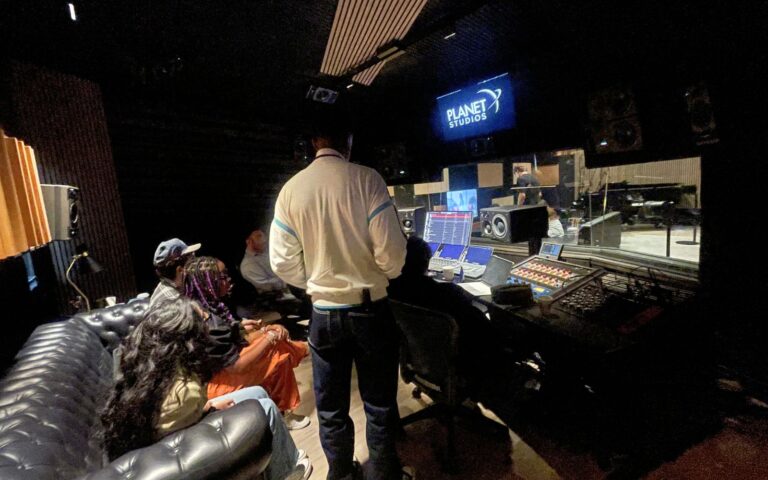
Sitting in the control room, surrounded by speakers, the familiar notes of “Rocket Man” lift overhead, then a mariachi track unfurls with such dimensional clarity you can practically feel the guitarists circling the room.
The demo serves as a gateway into Apple Music’s newest wave of software updates—tools designed not just to improve listening, but to make it more interactive, intuitive, and fun. Features like Apple Music Sing, which turns your iPhone into a microphone and your living room into a karaoke party; lyric-based search, expanded full-screen artwork, and Auto Mix all serve the same purpose: bringing fans deeper into the experience of music rather than keeping them at a distance.
Speaking later with Oliver Schusser, Vice President of Apple Music, it becomes clear these updates aren’t piecemeal additions—they’re the result of a decade-long philosophy about how digital listening should feel.
“We wanted to build a fan service, not just a streaming service,” Schusser says. “Music shouldn’t feel like a commodity. It should feel like art.”
That belief shows up throughout the app: human-curated playlists, time-synced lyrics, and a global network of Apple Music studios where artists create exclusive sessions and live recordings.
Quality—across audio, visuals, and design—is the guiding principle.
“In music, everyone has the same catalogue,” Schusser explains. “Our differentiator is quality—audio quality, feature quality, editorial quality.”
Spatial Audio represents the most dramatic leap in that pursuit, but Schusser hints more is coming. Tools powered by on-device intelligence and AI will continue to streamline discovery and enhance connection without overwhelming the listener or overshadowing the artist.
Ultimately, the Montreal studio session clarifies what Apple is really chasing: a future where listening feels physical again—where artwork matters, where sound moves with you, and where technology brings you closer to the music instead of flattening it.
And if what we heard in that room is any indication, that future is already here.
Listen to Apple Music’s vast Spatial Audio library here.