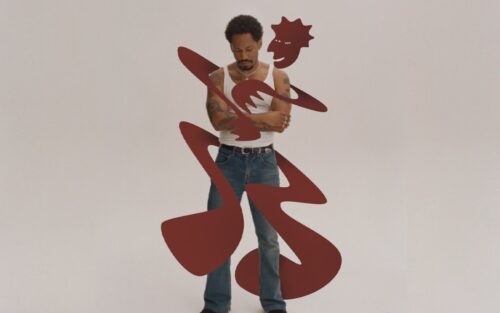


Across four albums orbiting a collision of hyperpop, electroclash, and darkwave, Cancade has told the story of a “gaylien” action superhero fleeing the darkness of planet Urth, creating a utopia called Planet Devours, and ultimately returning to Urth when Planet Devours catches fire and explodes. Throughout their intergalactic journey, Cancade’s protagonist — invariably clad in gothic robes with BDSM accessories, a spiked crown and diamond beard mask and red scorched earth attire with their head painted cosmic colours to match — wrestles with ego death, toxic gay masculinity, body dysmorphia, and hopelessness. But they also find empowerment and liberation in baring their insecurities.
Devours’ latest reinvention comes on the heels of entering a new decade of life. 10 years ago, Cancade self-released their first Devours album, Late Bloomer. “It was about the anxieties of entering my 30s, feeling unstable career-wise and unaccomplished,” he says. “I just turned 40, and I’m feeling unstable and unaccomplished.” Despite the challenges of remaining independent to this day, they’ve forged their own path, cultivating a devoted following along the way. In 2024, Cancade also earned their first Polaris Prize longlist nomination, for Homecoming Queen.
At age 40, Cancade has naturally segued into a soft mentor role in Vancouver’s music scene. “It’s been a mixture of emotions,” they confess. “I went so many years wanting to have some sort of audience or spotlight. Then when you get it, you want to stay in it.” Instead of being bitter or jealous of younger artists getting more attention, though, “I’ve worked really hard these past few years to age gracefully in the scene. I try to be grateful for the opportunities people gave me in my 30s and pass the torch to younger people, especially visible minorities or people who are needing it more right now. It’s the cycle of life.”
Channeling their complicated feelings about turning 40 into their latest album, Sports Car Era (out March 14 via Surviving the Game, Cancade’s own label), they wondered, “What does a midlife crisis look like for Devours?” Thus, they found themselves posing on the album cover in a bathing suit resembling American Apparel swimwear. When Cancade lived in Montreal in their early 20s, the fast fashion brand confronted them on billboards across the city.

“I didn’t want to just put on a blazer and find a sports car or do it too literally in terms of the male-centric midlife crisis,” Cancade explains. “The album cover is me wanting to relive my youth. I’m always thinking about going back to Montreal and trying to be in the scene there again and be accepted this time. The cover isn’t meant to be a thirst trap. It’s meant to be this defiant punk stance: ‘I’m not commodifiable anymore. Here I am at 40 in a bathing suit, on a fucking podium. Take me or leave me.’”
Sports Car Era is darker and more deconstructed than Homecoming Queen, its polished predecessor intended to lift Cancade out of depression. “A lot of people in my life are getting divorced and changing careers, and 40 isn’t what they were picturing it being, and it’s the exact same for me,” he says. “My midlife crisis feels like lots of existential anxiety and confusion about direction, but I want the album to celebrate that and be like, ‘It’s okay to be messy. Just throw on an American Apparel bodysuit and get sloppy.’”
By Glenn Alderson
To celebrate the release of Nouveaux Langages, we asked the artists who helped shape her new double album to ask the questions.
By Sofia Dawson
Daughter From Hell finds the songstress twisting the knife deeper.
By Sebastian Buzzalino
The Vernon quartet’s new album Rat Bastard is a fiercely alive mix of post-punk, dub, techno and basement-show energy.
By Kenna Clifford
Driven by the centuries-old sound of the shamisen, the Berlin-based quintet is deconstructing Japanese folk music and rebuilding it for new audiences around the world.
By Izzy Petraglia
The decade-spanning pop star held an immersive, phone-free experience for devout listeners to celebrate her new album, Music, Fashion, Film.
By Neil Jefferies
Alone Together finds the New York trio navigating grief, fatherhood and the uneasy distance between trust and suspicion.
By Sebastian Buzzalino
The Vancouver punk band bottle their chaotic live energy into a blistering black-and-white session filmed at Phony! Records.
By Cam Delisle
Paring alt-R&B back to its foundations, new avatar gives equal weight to songwriting, distance, and one of the genre's defining voices.
By Sophia Pan
Fire From the Hip finds the actor and musician taking control of his art – even if he can’t control who follows him there.
By Myles Tiessen
On Tell The Kids We Tried, the singer-songwriter wrestles with isolation and the quiet hope of feeling something at all.