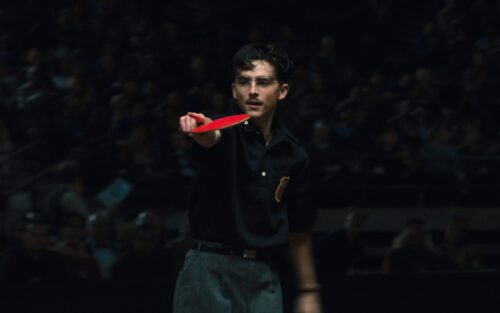


After staging a meet-cute at the retail store where he works, Matthew quickly infiltrates Oliver’s crew, becoming the de facto documentarian of the star’s cult of personality. Shooting music videos, snapping album covers, and worming his way into every scene, Matthew positions himself as Oliver’s “best friend.”
Though the beats sound familiar—The King of Comedy’s Rupert Pupkin or Misery’s Annie Wilkes come to mind—Lurker’s dissection of celebrity and transactional relationships is unnerving precisely because it resists exaggeration. Russell’s character study thrives on subtle gestures, quiet inflections that tap into the neuroses of our clout-chasing culture. Matthew’s menace comes from how ordinary he feels: more reflection than caricature.

For Théodore Pellerin, who stars as Matthew, this restraint was key. “I think the part was very well written,” he tells RANGE. “There were more extreme traits in earlier versions of the script—I auditioned three years before we shot it—and those were taken out. It became a lot more subtle, which was smart on Alex’s part.”
Pellerin’s performance—his wary gazes, his halting mannerisms—shows a man constantly calculating how to belong. “There is an aspect to him that feels like a shell,” Pellerin explains, “that allows him to fill it up with whatever needs to be in there to work with the people in front of him.”
As Matthew slinks through Oliver’s inner circle, he learns to impose his own rules after a devastating misstep. Lurker inverts the dynamic between the hanger-on and the star, revealing that celebrities rely on their orbiters as much as those orbiters rely on them. “What was most helpful,” Pellerin says, “was being curious about the little worlds a musician or celebrity can create around them… where everyone is their friend, but also on the payroll.”
The film’s most disquieting sequence crystallizes this power play: a playful wrestling match that curdles into something sinister, punctuated by Matthew’s eerie, perverse laugh. “It represents that Matthew knows what power he has,” Pellerin says. “When he brings Oliver to such an emotional state, that’s already a victory.”

That laugh becomes a warped anthem for the digital era’s social climbers, a reminder of how obsession and ambition can masquerade as friendship. “I was excited about playing a character that was minutely modifying himself in order to survive,” Pellerin reflects. “I’m not sure there are many people that exist like that… at least I hope so.”
Hope aside, Matthew feels disturbingly familiar. In an age of parasocial bonds, curated feeds, and endless lurking, Lurker doesn’t just capture the pathology of one character—it points the camera back at us.
Lurker is streaming now at mubi.com