

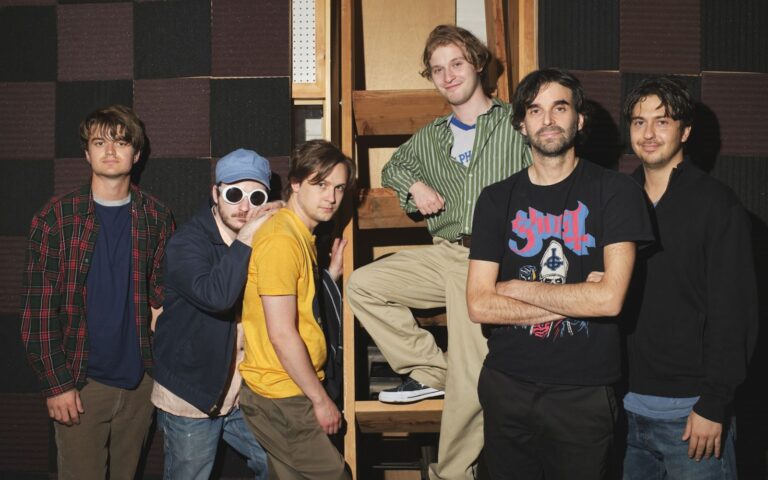

Pavements director Alex Ross Perry
Well, for writer-director Alex Ross Perry, that’s exactly the kind of sentiment that courses through every frame of his twisting, inscrutable documentary-film hybrid, Pavements. More akin to a Russian doll than a movie, Perry’s reflexive, extremely meta look at the band and its key members—Stephen Malkmus, Bob Nastanovich, Mark Ibold, Scott Kanberg, Steve West, and original drummer Gary Young—ponders “what if Pavement was the most important and influential band in the world?”
“That was my take that I sold the band and the label on,” Perry tells RANGE, “I said let’s pretend Pavement literally has accomplished the amount of success and wealth to necessitate or validate four, five, or ten movies like a Bob Dylan or The Beatles.” He continues, “There’s a David Bowie movie every couple of years and no one says, ‘not another one!’ but it makes sense that for one of the most significant figures of the 20th century, there is another take worth watching.”
“So, I said let’s presume that Pavement has received so much treatment, simply because in the minds of their most devout fans they are at that level—for 100,000 people, Stephen Malkmus is Lou Reed, he is John Lennon, he is David Bowie.” Perry continues, “Now that’s not backed up by sales or wealth, but it is backed up by musicianship and influence, just at a smaller level.” He notes “So the premise of Pavements is what if the band’s fame was a recognized fact, not an obscure opinion.”
To realize this slippery perspective, Perry’s film quickly breaks through the borders of its canvas, feeing less like one film but five incredibly different movies unfolding and overlapping at once. While Pavements is a straightforward documentary about the band, replete with archival footage and intimate interviews, it also follows their 2022 reunion tour, a pop-up NYC museum exhibit, and a pseudo-real musical stage adaptation of Slanted! Enchanted! Oh, and it’s also a mockumentary about the making of a fictional Pavement biopic starring Joe Keery, Jason Schwartzman, Nat Wolff, and Tim Heidecker, to name a few.

Joe Keery as Stephen Malkmus in Alex Ross Perry’s Pavements.
Perry blends all these narrative streams into what feels like a strip of acid, especially when they simultaneously unfold on fraying split screens. In vehemently defying categorization and definition, Pavements cracks open the traditional music biopic-documentary format and plays with the pieces to be the rare film to match the form, feel, and flair of its subject. In an epidemic of self-serious music documentaries that safely catalogue their subjects from afar, Perry’s film dives into the satirical muck with Malkmus and the bunch to dissect their legacy and oddly prove why they are “the world’s most important and influential band.”
Yet, the act of entwining these various and competing narrative streams was a feat easier said than done. “Credit is due to the film’s editor and producer Robert Greene, who found that balance.” Perry continues, “our greatest asset as collaborators is that we are fans of Pavement.” “I viewed them as an excellent subject for a film that examined the decade they were active—fame, identity, ambition, mainstream vs independent, cultural circles— and through this band you can tell this massive story,” He adds “I wanted to depict this story five different ways with different formats, approaches, meanings, and deconstruct everything that is real and not real about them…and then I handed it to an editor who says this is my favourite band of all time, and they have been since 1993.”
Perry notes “so what I had shot and what Robert wanted to edit sort of had tension and that was necessary towards making a movie with multiple points of view.” He continues “my point of view is that Pavement stands for a thousand different things and Robert’s point of view is that Pavement is the greatest band of my lifetime and I’m going to respect that in a film where everything the director did was about that and 10 other ideas at the same time.” This combination of experimentation and reverence allows Pavements not only to lampoon the cliches of the music documentary and biopic but also to reformulate them in a way that’s equal parts sardonic and heartfelt, but never schmaltzy or contrived.

Stephen Malkmus performing at Pavement’s infamous 1995 Lolapalooza gig in 1995.
This multi-pronged approach struck an immediate chord with the band, especially frontman Stephen Malkmus. “They just didn’t want something cookie-cutter and caught in what Malkmus called, ‘the legacy trap’,” Perry notes Malkmus “said don’t make the exact kind of thing about how cool the 90s were and how great we were…so I said we’ll depict the story different ways we’ll have people play you, we’ll have other people sing the songs, and he simply said that sounds cool.”
For Perry, the playfulness of the more fictional or, shall we say, “less real” segments were the most memorable. “It was very fun to make because we had a great group of people who really liked each other and engaged in a lot of ridiculous laughter.” He continues, “Schwartzman and Heidecker were making those endlessly rewarding.”
Perry adds “but everything was fun in its own way. You know you make a movie as an excuse to do stuff you want to do, like a I love archival work and curation, and it was really fun to play in this world for nine months.” Perry says “I love musicals, but I don’t know how to do them , and it was really fun for me to get to work in the theater, put on a show, work with experts who are amazing at choreography and arrangements… all of it really was just kind of a dream come true in a way.”
But for that dream to truly manifest, Perry wants Pavements to not only be remembered as an idiosyncratic exercise but a real film. “In the pantheon of such films, which is decades running at this point, there are very few films people can point to and say that one really was its own thing and that was really is a film,” he continues, “Martin Scorsese’s The Last Waltz is a film. Johnathan Demme’s Stop Making Sense is a film. All I wanted is to make something that, while existing in the somewhat ignominious genre of the music documentary, is for people to say you can’t talk about the highs of this genre without citing some of the formal risk-taking elements of Pavements.”
“Whether that happens remains to be seen, it’s a small movie about a beloved cult band, so it’s not going to reach as many people as a David Bowie movie.” Yet, in defiantly following its own beat, who knows, like the band it traces and mythologizes, Pavements might also soon be proclaimed, by a passionate group of cinephiles, as the most important and influential documentary ever made.
Pavements streams on Mubi July 11 — Sign up for your free 30-day trial at mubi.com/range