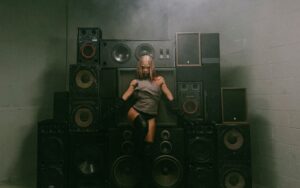
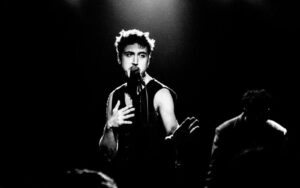
Elon Höglund and Emmanuelle Lê Phan were thinking about the magical interconnectedness of life and being when they formed the dance company Tentacle Tribe in 2012. Even though, at the time, it was just the two of them, “it was kind of like, how can we move as one person, together?” muses Höglund, speaking to RANGE on the phone from Montreal.
It wasn’t just about merging the dance styles they were trained in—which include breaking, contemporary, and martial arts—it was rooted in exploring a perspective that we all experience things differently and the sense of collective togetherness in that. The approach extends to the company’s latest production, Prism, which further explores ideas of reality and illusion in what Höglund describes as a “natural progression” of Tentacle Tribe’s artistic philosophy.
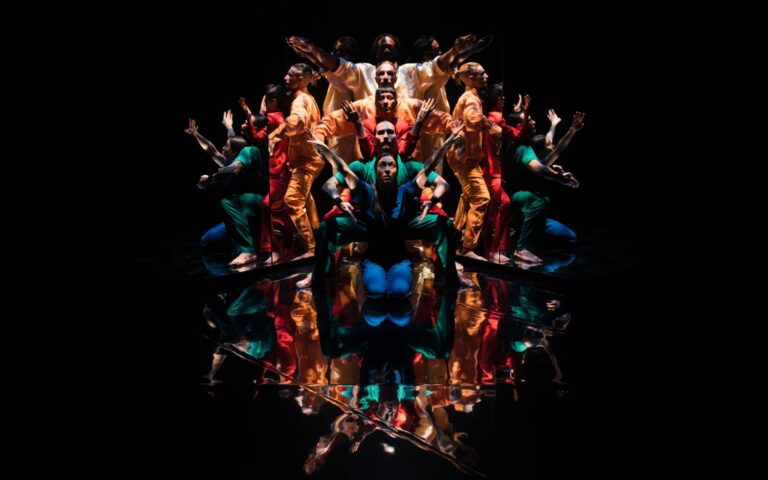
On stage at The Cultch’s Historic Theatre from October 23 to 27, Prism uses mirrors and light as a way to question what we see and cannot see. Mirrors multiply bodies and movement, distorting what’s real and what’s not. True to the title of the piece, this also relates to the use of light, given that the colours that make up a prism are simply the colours that we are able to perceive and, as Höglund notes, “not all there is.” In the show, light illuminates the dancers, dressed in primary colours, reflecting them as kaleidoscopic images with infinite angles.
“It’s a constant play of the physical and the nonphysical,” Höglund explains.
The set design features six moving mirrors that transform both the dimensions of the stage and the very perception of space itself. “It really feels like the set is a part of the choreography,” Höglund adds. “The set is like the sixth dancer. And the light is the seventh dancer. There’s seven colours on the spectrum. There’s only five dancers. So for me, the mirror and the light are representing the next two colours.”
Höglund created an original score for Prism. It’s the first full-length composition for a show he’s ever done, despite having a lifelong dream of making music. Using drones, orchestral sounds, and percussive beats, Höglund sought to evoke emotion through texture. The process for him was based on feeling, in order for the music to exist like an intrinsic presence. “I would look at the dancing [and think], ‘What do I see and what does it mean to me, and what would it taste like or what texture would it have?’”
Everything is connected. Even Tentacle Tribe’s diverse, signature movement style honours this in the way it breaks down techniques to find “optimal” ways of moving—“organic mechanics”—“to gain a greater understanding of how the body functions,” explains Höglund.
In Prism, self-reflection is the key that unlocks it all, both literally and philosophically. The production asks us all to look inward, using the mirror as a tool to apply such introspection in an attempt to better understand ourselves as well as those around us.
The conclusion, says Höglund, “at least for us, [is] that if you want to change something, maybe the only thing you can actually change is yourself.”
Catch Prism on stage at The Cultch’s Historic Theatre (YVR) October 23 to 27 | Tickets & Info