

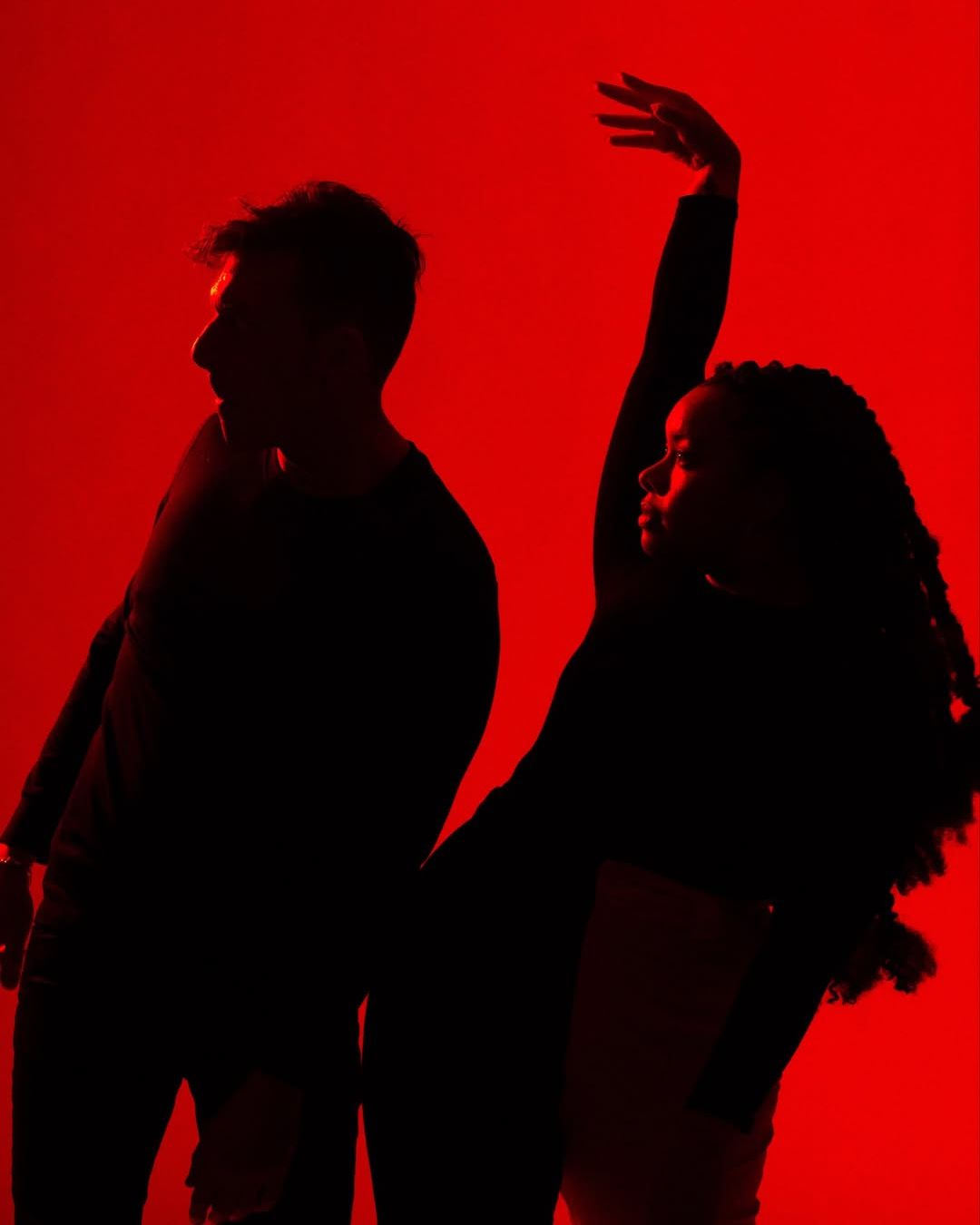
“Push II” arrived with the same heaviness but a sharper urgency. She and Jamie wanted a driving dancefloor tune that also reflected the moment they were living through—the real-time fall and burn of society. It’s analog synths that conjure existential dread while your house shakes in a storm. It’s watching the world burn through a screen. “Who are we? What risks and sacrifices are we ready to take for liberation? What are we willing to risk for our own freedom? For many people, typically, it is death. For many, many people, for our ancestors, period. People will die.”
As rain crackles through our call, Kamilah apologizes and dives into the lore behind TUSH. She and Jamie met in another band that wanted to go full-tilt disco; soon, both felt a tinge of “dis-gust,” as she puts it.
“It was a capital-T Thing,” Kamilah says. Jamie adds: “There was a lot of tokenization and fake afro wigs and things that were happening that were not the connections we wanted… it’s associated with the commercialization and white-washing of disco.”
“I wanted to separate myself from the fetishization of what happened with my image and for a while we took disco out of our social media name and I kept trying to distance myself from that,” says Kamilah.
So what is disco to TUSH? Jamie unpacks the shared lineages of disco, house, techno, funk, soul, and Caribbean music with encyclopedic ease. For him, the genre is a lineage of dancefloor traditions shaped by queer spaces and Black creators—less a category than a feeling. “For a lot of the creators, especially in the formative years of these genres, they’re not necessarily calling it anything. They’re just calling it the music they want to make in that moment.”
For Kamilah, it’s even simpler. The music she makes is Black music—what played on Saturday mornings while her family cleaned the house. Genres didn’t matter. What she understands as disco is the culture she grew up in and what comes out when she sings.
Her powerful pipes ground TUSH’s thoughtful, embodied revolutions. Jamie’s a meticulous builder—on bass, drum machines, in the studio, or behind the decks. Their sound always folds in organic elements: “Like A Rock (Maybe)” samples Kamilah clacking stones together on a Nova Scotian beach in the EP’s early days.
A voice note her friend presidukes left her one day happened to fit perfectly into a track they were building. “The Fit”—a black-and-white striped ensemble with a frilled collar and white boots—becomes its own character over a loop of bouncing bass and sultry “yeah baby”s.
“It is just as impactful to keep disco and keep a relationship and connection to disco and funk music and practise it in a way that feels true,” Kamilah says. “I don’t need to look like that characterization… I don’t have to do those things for it to be IN the family and community of disco and dance music. All we have to do is make music that is true. And that’s it. We get to claim that. It’s been nice to let go.”
In late October, Hurricane Melissa devastated the Caribbean. TUSH responded with their latest merch drop doubling as a relief fundraiser for Black River, Jamaica—a coastal community in crisis.
“As we talk about the land and the change and the political and social climate, this is one of the outcomes,” Kamilah says. “This is heavy weather and working through what our climate is environmentally—literal climate.”
At Toronto venue Standard Time, TUSH celebrated the release of Heavy Weather with a double launch alongside electronic duo Phèdre’s Liquid Consistency. VJ Almondiq covered the walls in drippy, glitchy visuals while DJ MeTime opened with movement-minded selections. The event also marked their first merch drop, raising over $6,000 for Kamilah’s family.
On the fundraiser page, she highlights the musicians, artisans, and spiritual leaders in Black River, even linking out to her cousin’s YouTube channel. The stakes are personal: on TUSH’s 2021 debut Fantast, her family appeared on interludes like “Auntie,” offering wisdom in her own sonic lineage. Today, one auntie needs a new roof; another lost her home completely.
Gaining deeper connection to the land has reframed Kamilah’s songwriting and TUSH’s purpose. “I really did feel a pressure in our earlier years… I really felt a pressure. I don’t know how to present myself, especially with this beginning I had as this ‘disco girl.’ I felt very pigeonholed. Fantast was a big fuck you to that, because it was such an eclectic mix of things.”
Now, she says, “I feel more settled.”