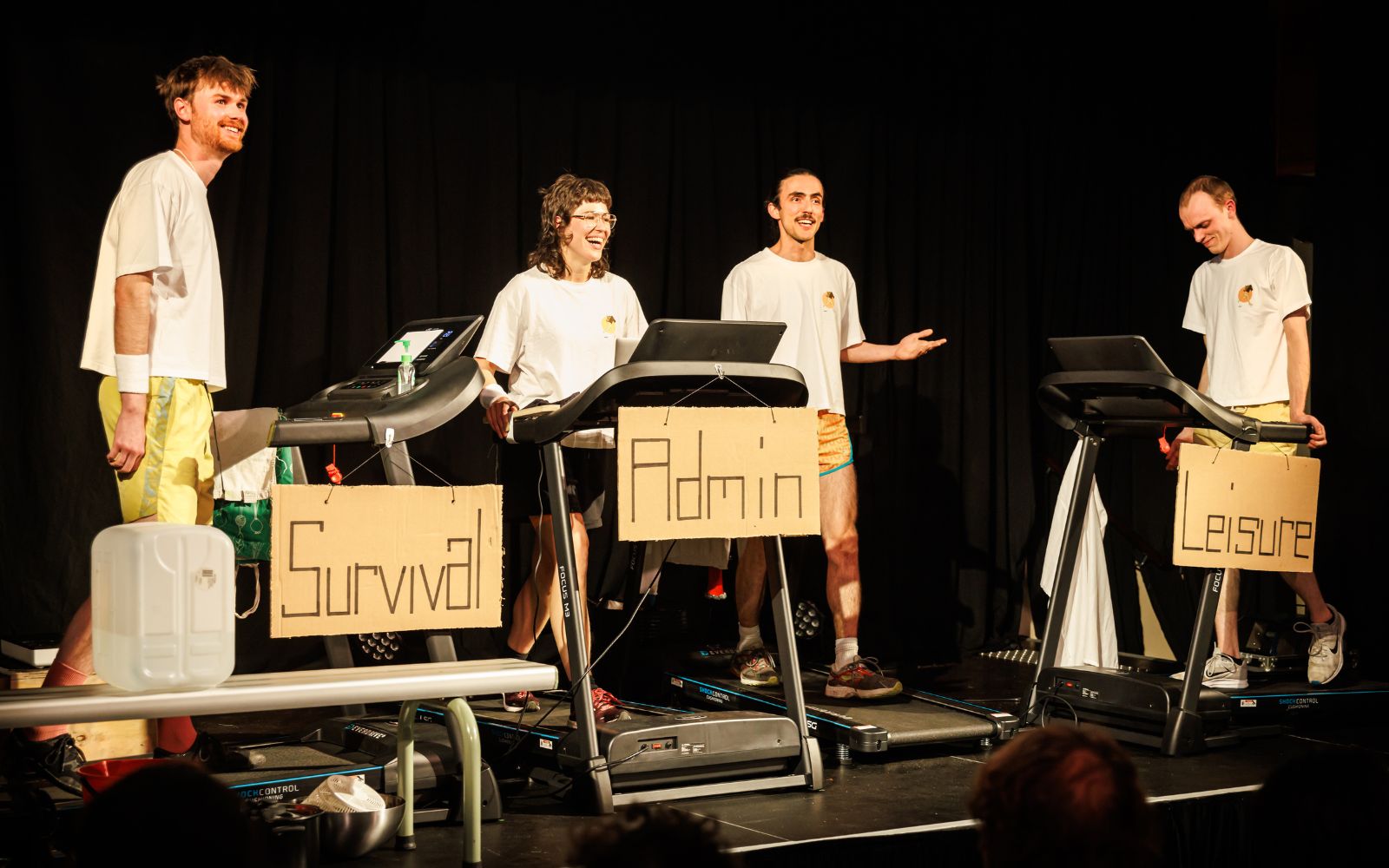

RANGE talked to Dominic Weintraub and Hugo Williams, two of the performers who turn multitasking into performance art, about what it’s like to sweat through the literal and figurative grind.
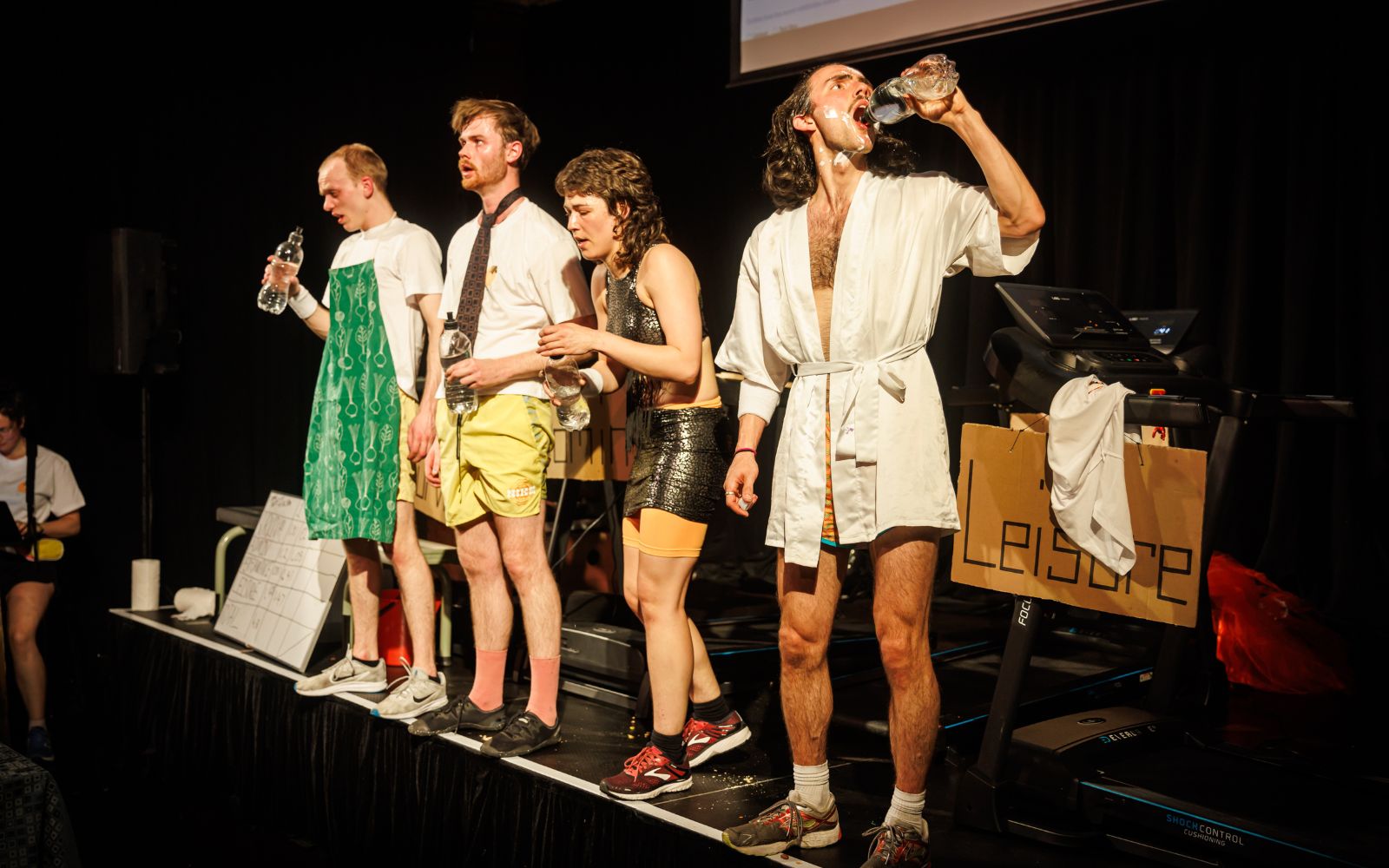
Burnout Paradise asks a lot from the body – what was your initial reaction when you learned you’d be performing on treadmills?
Well, we made the show so we’ve got no-one to blame but ourselves. It’s an exciting proposition though – you can’t fake the consequences of running on a treadmill, so the performers and the audience are both faced with the real sweat, mess, and chaos of the moment. There’s an immediacy in the room which is lovely to share with audiences. That being said, when I’m running as hard as I can with an audience member painting my nails and a mouthful of beer, there’s no denying that it’s a struggle.
How do you prepare physically and mentally before a show that’s so demanding?
In the beginning, we just had to survive two weeks of this show. For me, that meant learning how to run. I couldn’t survive a seven minute jog around the block without needing three days for my calf muscles to recover. Turns out I’d never bought a pair of shoes that fit either.
Now that this show keeps churning (much like life), I’ve found some ways to cope. I’ve built a really good relationship with my dance physio and the guy at the Brooks Direct Factory Outlet. I can’t speak for everyone in the company, but during show season I’ll do an hour of physio to strengthen my inactive glutes and release my overactive TFL. I’ll often forget to warm up my voice, do a few trills, and jump on the treadmill. In the down time, I keep putting running training on my to-do list and probably won’t get to it for months (guilty).
Mentally, it feels like I can really come to this show as I am. There are days when the last thing I want to do is get on the treadmill, and I will mope about doing my physio up until the last possible moment. But once I hear that three-beep treadmill countdown, I’m in. That’s possibly the beauty of doing a show without a character. I can come as I am, and be responsive to the energy of the audience. Every show provides new relationships and connections and that feels important.
Has performing Burnout Paradise changed the way you think about your own relationship with work or exhaustion?
That’s a complex question. On one hand, Burnout Paradise has presented us a wonderful, rare opportunity to travel the world, share our work with diverse new audiences, and contribute to global cultural conversations through international festivals. On the other hand, the show costs a lot from us to perform. We push our bodies to their limit every night, and over time we have racked up scars – physical and emotional – from this show. In Vancouver, we will hit our 100th performance of this show in 2 years, which is an immense privilege. The exhaustion is building, and each show gets a little harder, but for now the excitement outweighs the burnout.
What’s the hardest or most absurd task you’ve had to pull off mid-run?
Eaten a wheel of Brie. Blown up a beach ball. Skulled a warm pint of beer. Kissed an audience member. Re-enacted the opening scene of Mission Impossible 6. Vomited.
There’s a vulnerability in showing fatigue onstage. Was that vulnerability something you leaned into or had to learn to accept?
Our whole practice is about exposing vulnerable parts of ourselves in order to create communal experiences. So this show was quite purposefully designed to allow failure and fatigue to be front and center. We talk a lot about authenticity and authentic action, and whilst fatigue itself is not the goal, the way it allows us to be more authentic with where we are at does feel important.
Audiences seem to become more and more invested as fatigue sets in, not because we are tired, but because the feeling is so clear to them, so clear in their own bodies. In this way, the fatigue is less about us being vulnerable, and more about creating a mutual space of vulnerability, between us and an audience.
What’s the most terrifying or exciting thing about bringing Burnout Paradise to a new audience in Canada?
The show relies so heavily on its audience and audiences are so different from place to place, so it’s always exciting to bring Burnout Paradise somewhere we’ve never been before. For Canada specifically, Canadians have such a strong reputation of generosity. That care is going to be invaluable in building the community the show requires. On a personal level, William’s brother lives and works in Canada as a circus artist so the opportunity to see some of the places (and hopefully people) he’s been is awesome.
How do you hope Vancouver audiences see themselves reflected in this piece?
We know Vancouver audiences will see themselves, because the show is largely a giant mirror that reflects back the spirit, energy, and care of the audience in that space. Specifically we hope Vancouver audiences see their lives in ours and through doing so appreciate that the things we perhaps think are individual or deeply personal problems are actually communal, shared problems. The more we think they are just affecting us, in some miraculous way, the more we pull apart as a community.
What does trust mean in a performance where you’re literally running beside each other the whole time?
Having worked together for over six years, and trained together nine, I think trust is inherent in the company. There’s trust in having each other’s back, but also trust in each other to know themselves and their bodies and communicate what they need, especially if something goes wrong.
Get tickets to Burnout Paradise at Vancouver’s The Cultch here.